Be Good

What is it that we desire to see in ourselves, years after all the effort we exert to become better people, or at least, people more well aware of their shortcomings, and thus more capable of navigating them with minimal damage to those around them? Do we look at our parents and think, this is where they went wrong, and I’ll never be like them, but we only end up being faulty people in other ways that we’ve failed to anticipate? or do we look at those who we think are better, and somehow try to discern their road to improvement, only to find ourselves on a different road entirely? Who can truly tell? It does seem like there’s no one way, or some others may say that there’s no road at all.

Is it that life has never been easy, or is it that we make life more difficult for ourselves? The answer probably is that there’s an element of truth to each of those ideas. Every day a new door to awareness opens, and with it questions and anxieties that come cascading down the waterfall of our thoughts, and with age the boulders just become bigger and much less avoidable. But I also reject the idea that being a good person is somehow a challenge, or an exercise in difficulty, I refuse to think that decency is some sort of test that most people fail somehow.

People love to point to the concept that if there was no oversight, everyone would revel in mischief, and those who wouldn’t would become sheep amongst wolves, destined for consumption. And perhaps examples in everyday life do corroborate that idea; witnessing corruption take over entire establishments and countries, and people following suit. How can you not think that we are inherently awful?

But I would say that said awfulness is not inherent, but indeed learned through years of cruelty and laissez-faire attitudes that warp people’s minds into thinking that it is an eat-or-be-eaten world out there. It is not difficult to be decent, but it is equally easy to teach a child that taking things by force is the only right road, that women are inferior, that you always have the right of way, regardless of what you’re doing. When you live in a cruel uncaring world, reflecting that cruelty back at the world becomes a means of survival, without any consideration of what lies beyond that cruelty. Had there been an inkling of a desire for introspection, I do not doubt that one might realize that they wish to be decent, or at least not as cruel as the world made them to be. They just never get to choose.

Choice is indeed a luxury, and maybe what we ought to do is try to give everyone the choice we possess. What comes out of that might be a surprise, to us and — more importantly — to them.
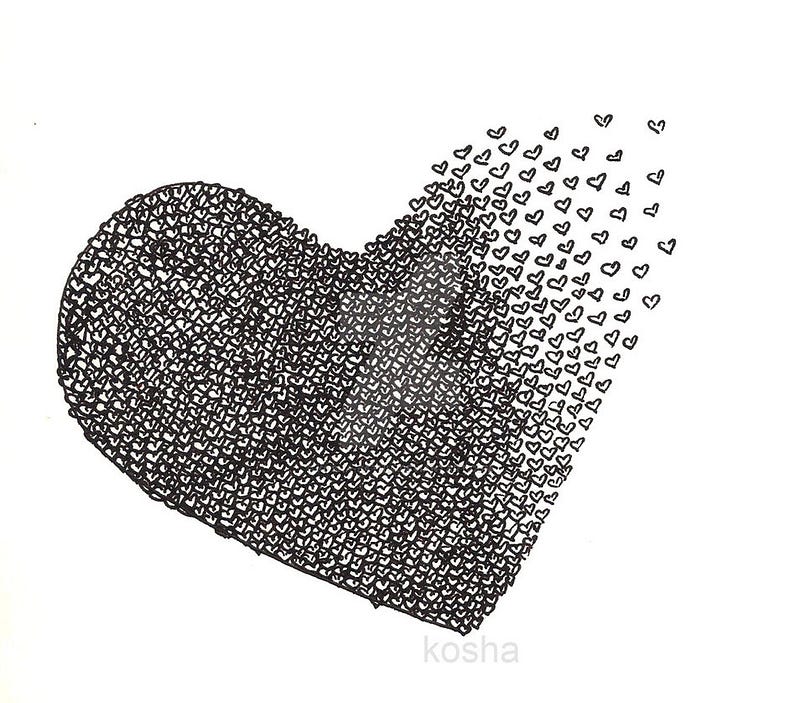
The Grey Language of Love

Source: http://kosha-bathia.deviantart.com/art/My-heart-s-a-fading-356371578

Not too long ago, I used to write these little poems; words of endearment towards a loved one which I hoped would brighten their day. But now I go back to those poems, and I feel like the words are devoid of any meaning whatsoever.

Now, you might roll your eyes at this, thinking ‘Well, of course. That relationship is over. Why would the words still hold meaning?’ And perhaps that is part of the reason. But the larger, less explored issue here is how the language of love has become overused to the point of meaninglessness.

You know how, if you say a word too many times, it starts losing its meaning and you start thinking it just sounds funny? I feel like this is the case now with such proclamations of affection. Think about it; all those phrases and metaphors and grand statements. Waxing poetic on how someone’s face is sculpted like an ancient goddess, or how their eyes catch the light of the sunset, or how their rippling hair seems to remind you of the endless ocean. These all sound nice, but are they really reflective of the love you feel? Or are they just words, bound to be repeated over and over as time goes by?

Mind you, I do not say that those who use it do not mean it. On the contrary, I feel like it’s not easy to come by these words, and so they’re probably being truthful. However, I personally feel like I’ve lost interest in them. You can come up with some colossal proclamation of love, something that belongs in a romance novel for the ages, and I would still feel like it fails to capture the essence of it all.

But why is that the case?

Perhaps it’s become too impersonal, this vocabulary of love we utilize. All these words we share with loved ones, the words we hear in songs and movies and shows every single day. They’ve all become faded, overused and in need of retiring, if only for the sole purpose of giving them meaning again. Otherwise, one day you’ll be told you’re someone’s shining star, and all you’ll manage is a shrug.

‘Sure, like I haven’t heard that before. Boring.’

For me at least, it seems like I’m infinitely more interested in the love we allude to, rather than that we proclaim. The minute details of someone’s life and actions, which reflect the feelings they have for someone else. Beyond any accusations of faking emotion or words, there is a present, unique value to these details that is richer — if not more ornate — than any word I can think of.

So perhaps the next time I write a poem, I’ll think less about the words being written, and more about what the action of writing itself indicates. Maybe then I’ll feel better about it.

Oculus


There was a moment, during my recent corrective surgery, where the doctor attempted to gently open a flap that was created using a pretty precise. laser. Problem with that is the fact that the flap is rather tiny, and often fibers from within the eye itself are not completely sliced. So the doctor has to use a set of pliers to gently pull and nudge at the flap, until those fibers yield and the incision is clear.

It was days later that it occurred to me how you and I seem to have followed a similar trajectory.

I honestly do not know how it happened. But something got in there pretty fast, and a bond that ties us together seemed to have been cut altogether. I played it back in my mind a thousand times, to make sure I hadn’t missed anything. But no, it was all just fine.

Until it wasn’t.

And if I thought that was confusing, then I cannot begin to express how I felt when, over the following days, I watched as something invisible tugged at the torn flap in our relationship, while strands of tissue awkwardly stretched and then gave way in resignation. It was in our interactions, in the way we avoided looking at one another, in the stunted conversations and the too-long pauses that seemed to punctuate every attempt to work against that indelible force.

But it just felt like an inevitability after a while. I realized that I was starting to treat it like it was the new norm; I was leaning into the gusts of dissolution, letting them drive me away from you. I knew that I was probably coming across like a total ass, but it seemed like you too had accepted the new status quo, and we were just merely engaging in the necessary dance of separation.

If I were to attempt to describe how it felt, and still feels sometimes — whenever I let it, that is, I’d say that my brain catches fire; it blazes with too many thoughts and questions and emotions that I end up just shutting it all down. I do so because, I know that if I were to let it go on, it would just burn endlessly, seeking an answer that simply doesn’t exist. Who knows why these things end? Sometimes there’s a clear instigating incident, other times it’s a slow vague spiral into a grey nothingness. It’s not even thrilling, the way violent endings are.

Perhaps that’s the thing that saddens me the most; the apathy in which we seem to have both drowned in.

— — -

After the flap is successfully shorn aside, the doctor utilizes the laser to make the necessary corrective changes, and then methodically realign the flap against the cornea, giving it the chance to naturally heal. A part of me, a not-so-small part, wishes the analogy would carry through to this conclusion instead. I’m hoping this tear allows for a reunion in the future, one that houses a healthier, stronger core, that gives us the gift of a sharper image of what is to come.

Memento

Sometimes there are these memories, tiny in duration, but colossal in effect, that come into one’s mind. They are unbidden, and often unwelcome, but suddenly they’re there, and all you can do is just deal with them.

Maybe it’s something as simple as the way the wind feels on your skin, or the way the light hits the steering wheel of your car as the sun sets and you’re driving home. Maybe it’s the sound of a notification on someone else’s phone, that reminds you of a time when you used that same tone, a long time ago.

Isn’t it weird, though? How our brain tends to associate these seemingly very simple things with people and events? And what’s more frustrating is the fact that, no matter how hard you try, you’ll never be able to share that feeling with someone else. After all, the Pensieve only exists in Harry Potter books. So for others, these memories are just related through words and images, but they’re never the same thing. How can you relate a memory of warmth to someone who’s never experienced it the same way? Or the feeling of someone’s skin against your fingertips? It’s never exact, only relayed via a noisy medium, with losses along the way. The most unfortunate game of telephone there is.

And even if you could, how would you ever tell them how it feels to remember those things? Would you tell them that they rend your heart asunder? That they make you sigh so heatedly, you’d think that the flames in your chest are still there — even when you know that all that’s left are embers and ashes?

You can’t, but you’ll keep trying.

Because the memory is worth it.